
Dental SEO and marketing that fills the diary
Dental marketing that fills the diary with the treatments you actually want to do.
Illustration. London City Smiles ranks #1 for “Dentist in Islington”.
Dental practices compete on a small map. Most patients search “dentist near me”, “emergency dentist” or a named treatment, then choose from whoever appears in the local pack and the AI answer above it. Terrier works on both: the local and organic rankings that win the click, and the AI visibility that increasingly decides which practices get named at all.
How we help dental practices
We build treatment-level pages that rank. Implants, invisible aligners, veneers and hygiene plans each get their own page, rather than one thin “treatments” page that competes for nothing. We fix the technical foundations, tighten your Google Business Profile and location signals, and earn the local links and citations that separate a practice from the group down the road.
Dental content carries real regulatory weight. Claims are governed by the General Dental Council’s standards for the dental team and the ASA’s advice on dental advertising, so everything we publish is written to be persuasive within those limits. No before-and-afters that cannot be substantiated. No guarantees that cannot be made.
Reporting is on the numbers that matter to a practice: enquiries and bookings by treatment, not impressions.
What’s included
Treatment page architecture.
A dedicated page per treatment, rather than a paragraph buried in a services list, built to rank and convert on its own.
Location pages for multi-site groups.
One page per practice address, built to compete on “[treatment] + [area]” queries without duplicating content.
LocalBusiness and Dentist schema.
Structured data that correctly identifies each practice location, its hours and its registered status.
GDC and AHPRA-safe claims copy.
Every page written and checked against advertising rules before it goes live, rather than audited after the fact.
Appointment-tracking setup.
Call tracking and booking-form events wired into analytics so you can see which pages actually produce appointments.
Google Business Profile and reviews.
Your profile and location signals tightened, with the local links and citations that set a practice apart.
Patients search before they book
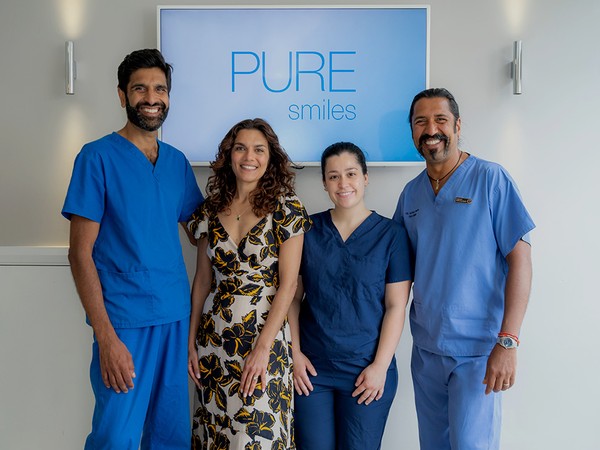
A patient looking for a new dentist rarely starts on Google Maps. They search the treatment first. “Invisalign cost London”, “emergency dentist open now”, “private dental implants”. They read two or three sites, then check reviews before they pick up the phone. A homepage and a generic “services” list is invisible for every one of those searches. Pure Smiles had exactly that problem before we rebuilt their content programme, delivering a 37%+ increase in organic traffic and a 47% increase in appointments. Dental SEO is the work of owning every treatment query a patient types before they trust you enough to book. Ranking for “dentist” in a city you already dominate on brand searches is the easy part.
The treatment pages that earn bookings
Five treatment types account for most of the search demand a general or cosmetic practice can realistically win. Invisalign and clear aligners, dental implants, emergency dentistry, teeth whitening, and hygienist appointments. Each follows the same pattern: the treatment itself, paired with the qualifiers patients actually search. Cost, “near me”, “same day”. A page titled simply “Invisalign” competes with national aggregators. A page built around “Invisalign cost in [area]” and “same-day emergency appointments” competes with the local practices patients are actually choosing between. London City Smiles built exactly this kind of page structure and took the #1 result for “Dentist in Islington”, ranking for 1,079 keywords within ten months, with 166 reaching the top 20.
Proof
A 37%+ increase in organic traffic, a 47% increase in appointments, and a 66% increase in non-brand organic visibility, from a rebuilt content programme and a digital branding overhaul.
Read the Pure Smiles case study#1 for “Dentist in Islington”, 1,079 keyword rankings within ten months, and 166 of those in the top 20, built on a site overhaul and a consistent content strategy.
Read the London City Smiles case studyAesthetic clinic search and content work across a multi-site group, run to the same treatment-page and compliance standard.
Read the Sisu Clinic case studyCase Studies
Our work in the Dental sector

Get a free dental SEO audit
Not sure where your site needs work? Run our free website SEO audit.
Get my free auditFree instant SEO audit of your website
Checking your site. This usually takes under a minute.
We could not run the audit just now. You can still run it on the audit page.
Go to the audit page90-day plan for a single practice
Month one is diagnostic.
A technical and content audit, treatment-page architecture mapped against your patient volumes, and the LocalBusiness and Dentist schema corrected or built from scratch.
Month two is build.
The priority treatment pages go live, GDC or AHPRA-checked, with appointment tracking wired in from day one so results are measurable rather than assumed.
Month three is proof.
Early ranking movement on the highest-intent treatment terms, a first read on which pages are producing tracked appointments, and a prioritised list for months four to six.
Compliance
Dental marketing is regulated, and we write to the rule that applies rather than treating claims copy as an afterthought. In the UK, the General Dental Council’s standards prohibit misleading claims, require any comparative or superlative statement to be substantiated, and restrict how before-and-after images and testimonials can be used. In Australia, AHPRA’s advertising guidelines for regulated health services prohibit testimonials about clinical care outright, ban claims that create unrealistic expectations of results, and require any comparison to other practitioners to be accurate and substantiated. We write to these standards from the first draft, and we flag anything a practice sends us that would not clear them.
What dental SEO costs
- Single-practice site
- No minimum term
- 60 days’ notice
Ongoing dental SEO inside a retainer starts from £1,250 a month, ex VAT. That is the same entry tier as the rest of our SEO work, sized to a single-practice site. Multi-site groups scope differently, because the location-page and schema workload scales with the number of practices rather than treatments. There is no minimum term and 60 days’ notice applies at any point. See SEO pricing for the full breakdown.
See SEO pricingFrequently Asked Questions
It uses the same local-ranking mechanics. Google Business Profile, reviews, local links. It adds a layer general local SEO does not need: treatment-specific pages built around what patients actually search before they book, and copy written to pass GDC or AHPRA rules rather than generic marketing claims.
No. A generic services page competes against national aggregators and other practices with dedicated pages for the same terms. Treatment-specific pages are what let a single practice compete on cost, location and same-day qualifiers rather than the bare treatment name alone.
Yes. That is built into the process rather than added afterwards. Every treatment page is written to the advertising standard that applies to your practice’s jurisdiction before it is published, and we flag anything a practice supplies us that would not clear it.
Yes. The £1,250 entry tier is scoped to a single practice. A multi-site group needs a location page per address plus schema for each one, so it is scoped separately. See SEO pricing for how that works.
Treatment pages typically show ranking movement within two to three months. The appointment-tracking setup in month one is what tells you whether traffic is converting to booked appointments, rather than assuming it from rankings alone.
Yes. For a single or multi-location practice this sits alongside the treatment-page work, using the same foundations covered on our local SEO service.
We write to whichever advertising standard applies to the practice being marketed. GDC rules for a UK site, AHPRA guidelines for an Australian one. We keep the two separate rather than applying one country’s rules across both.
Yes. See the London City Smiles and Pure Smiles case studies for the ranking and appointment numbers behind both.
The first thing we establish is whether the problem is visibility or conversion, because they need different fixes. A practice ranking well for its town name while the diary stays empty usually has a treatment page problem or a booking problem, not a ranking problem. We look at which treatments actually generate the traffic, what those visitors do next, and where they drop out. We report against enquiries rather than ranking positions. If search is not your constraint, we will tell you that rather than sell you a retainer.
We will not put a figure on that before looking, and we would be cautious of anyone who does. After the audit we can show you the search demand for each treatment in your catchment, what share of it your pages could realistically win, and what your current site converts visitors at. That gives you a range built from your own numbers rather than an industry average. It is less satisfying than a promise. It is the only version that holds up once the work starts. Our entry retainer is £1,250 a month with no minimum term and 60 days notice at any point, so you can stop if the numbers do not appear.
Ready to fill the diary?
Dental marketing that fills the diary with the treatments you actually want to do.
Schedule a Free Call